
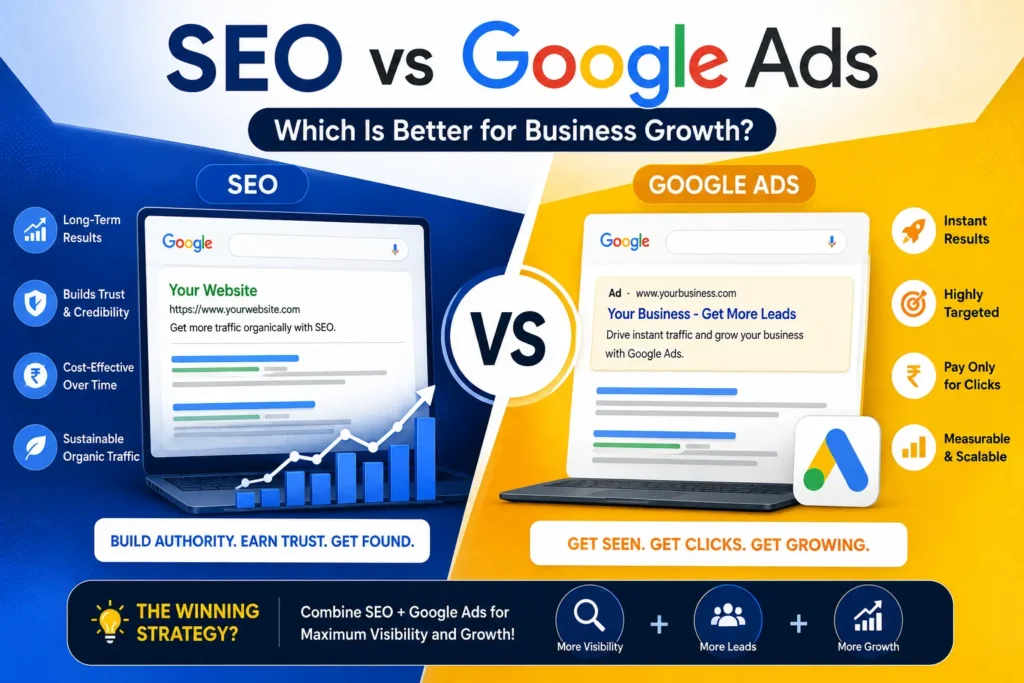
If you’re looking to grow your business online, you’ve probably asked yourself one important question: Should I invest in Search Engine Optimization (SEO) or Google Ads? Both are powerful digital marketing strategies that can help businesses generate leads, increase website traffic, and boost sales. However, they work in different ways and offer different advantages.
Many business owners believe they must choose one over the other, but the reality is more nuanced. The best strategy depends on your goals, budget, timeline, and competition.
In this comprehensive guide, we’ll compare SEO vs Google Ads, explain the pros and cons of each, and help you decide which option is right for your business in 2026.
What Is SEO?
Search Engine Optimization (SEO) is the process of improving your website so it appears higher in Google’s organic (non-paid) search results.
SEO involves optimizing your website’s content, technical structure, user experience, and authority to increase visibility when users search for relevant keywords.
For example, if someone searches for “best digital marketing agency in Bangalore,” an SEO-optimized website has a better chance of appearing on the first page of Google without paying for each click.
Key Components of SEO.
- Keyword research
- On-page SEO
- Technical SEO
- Local SEO
- Content marketing
- Link building
- Mobile optimization
- Website speed improvements
- User experience (UX)
SEO is a long-term investment that builds sustainable organic traffic over time.
What Are Google Ads?
Google Ads is Google’s pay-per-click (PPC) advertising platform that allows businesses to display ads at the top of search results, on YouTube, Gmail, Google Maps, and across millions of websites in the Google Display Network.
With Google Ads, you bid on keywords relevant to your business. When someone searches for those keywords, your ad can appear above the organic results.
You only pay when someone clicks your ad.
Google Ads is ideal for businesses that want immediate visibility and faster lead generation.
SEO vs Google Ads: Key Differences.
| Feature | SEO | Google Ads |
|---|---|---|
| Cost | No cost per click | Pay for every click |
| Results | Long-term | Immediate |
| Traffic | Organic | Paid |
| ROI | Builds over time | Fast if campaigns are optimized |
| Trust | Often perceived as more credible | Marked as Sponsored |
| Sustainability | High | Stops when budget ends |
| Competition | Based on quality and authority | Based on bids and quality score |
Benefits of SEO.
1. Long-Term Organic Traffic.
Once your pages rank well, they can continue attracting visitors for months or even years with ongoing maintenance.
Unlike paid advertising, organic traffic doesn’t stop when your marketing budget is reduced.
2. Higher Credibility.
Many users trust organic search results more than advertisements because they believe they have earned their rankings through quality and relevance.
Ranking on the first page of Google also strengthens your brand’s authority.
3. Better Return on Investment.
Although SEO requires time and consistent effort, it often delivers one of the highest long-term returns on investment.
Once your website gains authority, customer acquisition costs typically decrease.
4. Supports Every Stage of the Customer Journey.
SEO helps users discover your business while researching products, comparing options, and making purchasing decisions.
Educational blog posts, service pages, FAQs, and case studies all contribute to stronger organic visibility.
Limitations of SEO.
SEO isn’t an overnight solution.
Challenges include:
- Results can take several months.
- Highly competitive industries require ongoing optimization.
- Search engine algorithms change frequently.
- Consistent content creation is necessary.
Businesses looking for immediate leads may find SEO alone too slow.
Benefits of Google Ads
1. Instant Visibility.
Google Ads can place your business at the top of search results within hours of launching a campaign.
This makes it ideal for:
- New businesses
- Product launches
- Seasonal promotions
- Limited-time offers
- Lead generation campaigns
2. Highly Targeted Advertising.
Google Ads allows advertisers to target users based on:
- Keywords
- Location
- Language
- Device
- Audience interests
- Demographics
- Time of day
This precision helps businesses reach customers who are actively searching for their products or services.
3. Measurable Performance.
Google Ads provides detailed reporting, including:
- Clicks
- Impressions
- Conversion rates
- Cost per click (CPC)
- Cost per acquisition (CPA)
- Return on ad spend (ROAS)
These insights help businesses optimize campaigns for better results.
4. Flexible Budget Control.
Businesses can start with small daily budgets and increase spending as campaigns prove successful.
Budgets can be adjusted or paused at any time.
Limitations of Google Ads.
Google Ads also has drawbacks:
- Costs can rise in competitive industries.
- Traffic stops when advertising stops.
- Poorly managed campaigns can waste budget.
- Continuous optimization is required.
Google Ads works best when campaigns are professionally managed and regularly optimized.
Which Strategy Generates Better Leads?
Both SEO and Google Ads can generate high-quality leads, but the timing differs.
SEO Leads.
- Long-term
- Highly trusted
- Lower acquisition costs over time
- Better for evergreen growth
Google Ads Leads.
- Immediate
- Highly targeted
- Faster conversions
- Excellent for scaling quickly
The ideal approach depends on whether your priority is immediate growth or sustainable long-term visibility.
Cost Comparison
SEO Costs.
SEO usually includes investments in:
- Website optimization
- Content creation
- Technical improvements
- Link building
- Ongoing maintenance
While there is no charge for organic clicks, achieving strong rankings requires consistent effort.
Google Ads Costs.
Google Ads costs vary depending on:
- Industry competition
- Keyword demand
- Quality Score
- Geographic targeting
- Campaign optimization
Businesses pay only when users click their ads, making budget management critical.
Which Delivers Better ROI?
The answer depends on your timeframe.
Short-Term ROI.
Google Ads often delivers faster returns because campaigns generate traffic immediately.
Long-Term ROI.
SEO generally provides stronger long-term ROI by continuously attracting organic visitors without paying for every click.
Many successful businesses use Google Ads for immediate growth while building SEO for sustainable success.
SEO vs Google Ads for Different Business Types
Local Businesses.
Recommended Strategy:
- Local SEO
- Google Business Profile optimization
- Google Ads for high-intent local searches
Examples:
- Dentists
- Clinics
- Restaurants
- Salons
- Real estate agencies
E-commerce Businesses.
Recommended Strategy:
- Product SEO
- Shopping Ads
- Performance Max campaigns
- Content marketing
Startups.
Recommended Strategy:
- Google Ads for immediate visibility
- SEO to build long-term authority
Established Businesses.
Recommended Strategy:
Combine SEO and Google Ads to maximize traffic, leads, and brand visibility.
Why Combining SEO and Google Ads Works Best.
Instead of choosing one strategy, many businesses achieve the best results by combining both.
Benefits include:
- Immediate traffic from Google Ads
- Sustainable organic growth through SEO
- Increased brand visibility
- Higher conversion opportunities
- Better keyword insights
- Stronger overall marketing performance
For example, a business can use Google Ads to target competitive keywords while simultaneously publishing SEO-optimized content to improve organic rankings over time.
Common Mistakes to Avoid.
- Ignoring mobile optimization
- Sending paid traffic to poor landing pages
- Targeting irrelevant keywords
- Neglecting conversion tracking
- Failing to update website content
- Overlooking technical SEO issues
- Running Google Ads without ongoing optimization
Avoiding these mistakes helps maximize both SEO and paid advertising performance.
Best Practices for Business Growth in 2026.
To achieve sustainable growth:
- Invest in high-quality SEO content.
- Improve website speed and user experience.
- Optimize for local search.
- Use Google Ads for high-intent keywords.
- Track conversions and analytics.
- Continuously test and optimize campaigns.
- Create valuable content that addresses customer needs.
- Build trust through reviews, testimonials, and case studies.
Final Verdict
So, SEO vs Google Ads: Which Is Better for Business Growth?
The answer depends on your goals.
- Choose SEO if you want sustainable, long-term organic traffic and lower customer acquisition costs over time.
- Choose Google Ads if you need immediate visibility, quick lead generation, or want to promote time-sensitive offers.
- For most businesses, the strongest strategy is to combine both. Google Ads can drive immediate results while SEO builds lasting authority and consistent organic traffic.
By balancing short-term wins with long-term growth, businesses can create a marketing strategy that delivers measurable results and supports continued success in 2026 and beyond.
Frequently Asked Questions (FAQs)
Is SEO better than Google Ads?
Neither is universally better. SEO offers long-term organic growth, while Google Ads provides immediate visibility and faster lead generation.
How long does SEO take to show results?
Most websites begin seeing meaningful improvements within three to six months, depending on competition and the quality of optimization.
Are Google Ads worth it for small businesses?
Yes. Well-managed Google Ads campaigns can generate qualified leads quickly, especially for businesses targeting specific products, services, or local markets.
Should I use SEO and Google Ads together?
Yes. Combining SEO and Google Ads often delivers the best results by providing both immediate traffic and sustainable long-term growth.
Which is more cost-effective?
SEO is generally more cost-effective over the long term, while Google Ads is effective for businesses that need immediate results and have a dedicated advertising budget.