
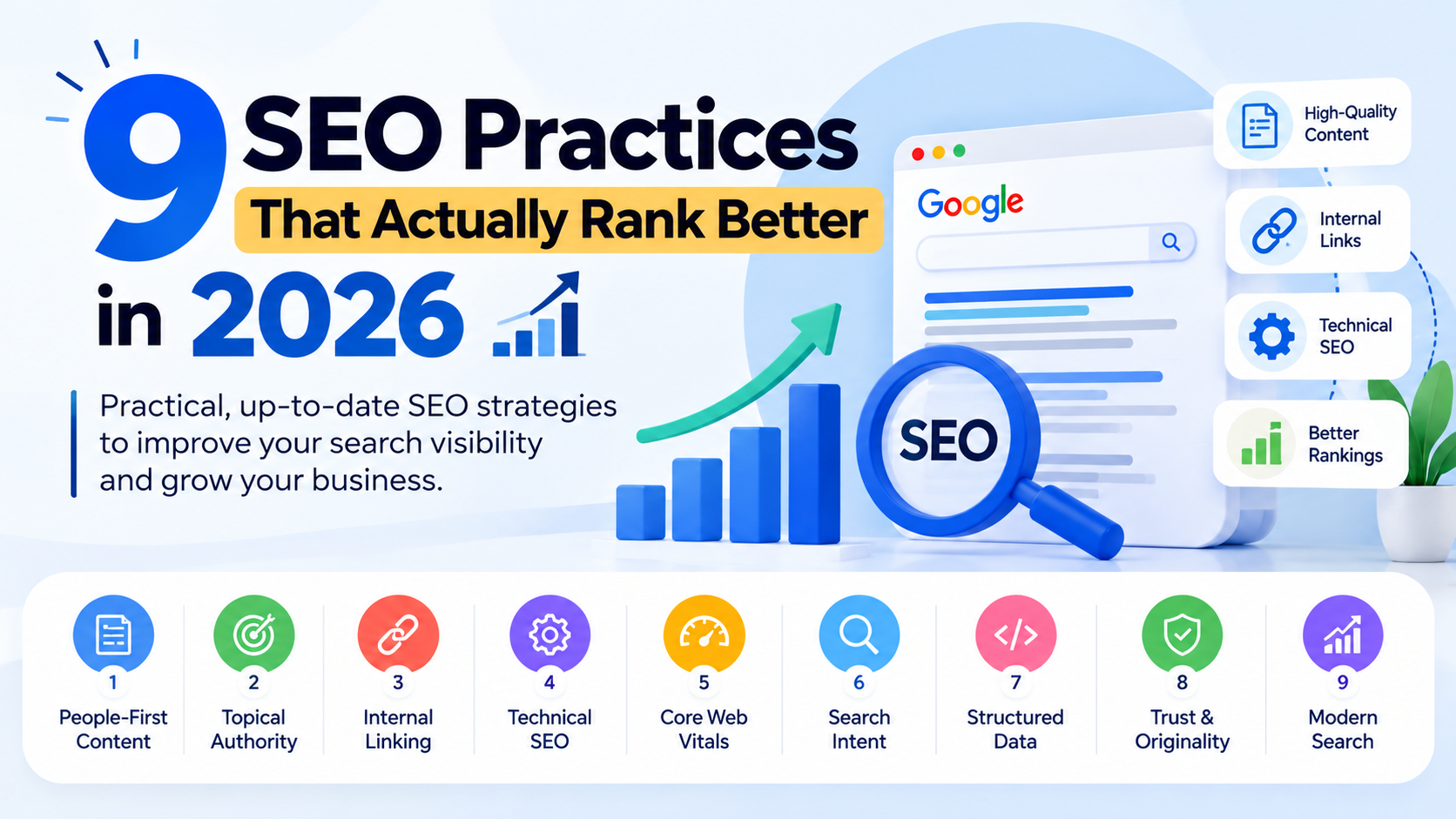
SEO continues to change as search engines become better at understanding content, user intent and the overall quality of a webpage. In 2026, businesses cannot rely on keyword repetition or outdated SEO shortcuts to build sustainable search visibility. A stronger approach combines useful content, search intent, technical SEO, internal linking, website performance, structured data, original expertise and a good experience for visitors. This guide explains nine practical SEO practices that businesses can use to improve their websites and build a stronger foundation for Google Search.
What Has Changed in SEO in 2026?
SEO is no longer simply about adding keywords to a webpage and waiting for Google to rank it. Search engines can understand relationships between topics, questions, entities, content and user intent much more effectively than before.
This means businesses need to think beyond individual keywords and focus on whether a page genuinely answers the user's question or helps them complete their goal.
Technical SEO, useful content, website experience, internal linking and trustworthy information all remain important parts of a modern SEO strategy.
1. Create People-First Content That Satisfies Search Intent
One of the most important SEO practices in 2026 is creating content primarily for people rather than writing articles simply to attract search engine traffic.
Before creating a page, understand what the person is actually trying to accomplish. Someone searching for 'SEO services Bangalore' may be researching agencies, comparing services or preparing to contact a provider. Someone searching for 'how to improve Google rankings' is more likely looking for practical information.
The page should match that intent instead of forcing every search into the same type of content.
Useful content should answer the main question clearly, provide enough context and help the reader decide what to do next.
2. Build Topical Authority Instead of Publishing Random Articles
Publishing a large number of unrelated blog posts does not automatically create a strong SEO strategy.
A better approach is to build groups of useful content around topics that are relevant to your business.
For example, a digital marketing agency could create a broader SEO topic cluster containing articles about keyword research, technical SEO, local SEO, Google Business Profile optimization, internal linking, content strategy and SEO reporting.
These articles can support one another through relevant internal links while giving visitors multiple ways to explore the subject.
The objective should be to build useful coverage around an important topic rather than publishing articles simply because a keyword has search volume.
3. Strengthen Internal Linking
Internal links connect pages within your own website and help visitors discover related information.
They can also help search engines understand the relationship between pages and the structure of your website.
For example, an article about SEO practices can naturally link to a detailed page about SEO services, while an article about local SEO can link to Google Business Profile optimization content.
Good internal linking should be useful to the reader. Avoid adding links simply to increase the number of links on a page.
Use descriptive anchor text that gives the visitor a clear idea of what they will find after clicking.
4. Fix Technical SEO Problems Before Publishing More Content
A website can have excellent content and still experience search visibility problems if important technical issues prevent search engines from properly accessing or understanding the pages.
Technical SEO should include checking crawlability, indexability, canonical URLs, robots directives, XML sitemaps, broken links, duplicate pages, redirects and important status codes.
Businesses should also check whether important pages are accidentally marked as noindex or blocked from crawling.
A technical SEO audit can help identify these issues before investing heavily in producing additional content.
5. Improve Core Web Vitals and Overall Page Experience
Website performance matters because visitors need to be able to access and use a page comfortably across different devices.
Core Web Vitals include measurements related to loading performance, responsiveness and visual stability.
Businesses should pay particular attention to mobile performance because many users access websites from smartphones.
Common areas to review include large images, unnecessary JavaScript, slow server response times, layout shifts, excessive page elements and resources that delay important content.
A high PageSpeed score by itself does not guarantee a top Google ranking. The objective should be to improve the real experience of visitors while also addressing technical performance problems.
6. Optimize Pages for Search Intent Instead of Keyword Density
Keyword usage is still useful because it helps communicate what a page is about, but repeating the same keyword excessively is not a sustainable SEO strategy.
Instead, understand the different types of search intent.
Informational searches usually involve learning about a topic. Commercial searches often involve researching products, services or providers. Transactional searches indicate an intention to take an action, while navigational searches are generally focused on finding a specific website or brand.
A page should be structured around the information the user needs rather than around a predetermined number of keyword repetitions.
Use related terminology naturally through headings, explanations, examples and supporting sections.
7. Use Structured Data Correctly
Structured data provides search engines with additional information about the content and type of a webpage.
Depending on the page, businesses may use structured data such as Article, Breadcrumb, Organization, LocalBusiness, Product or other supported types where they are appropriate.
The markup should accurately represent the visible content on the page and follow the relevant guidelines.
Structured data should not be treated as a shortcut to higher rankings. Its main purpose is to help search engines understand the content and potentially make the page eligible for supported search features.
8. Demonstrate Experience and Provide Original Information
One of the easiest ways to make an SEO article more useful is to include information that comes from genuine experience rather than simply rewriting information already available online.
For example, a digital marketing agency can explain common SEO problems it encounters when auditing business websites, how technical issues affect implementation or how different types of businesses approach local search.
Original examples, practical observations, screenshots, case studies, processes and explanations can make content more useful than a generic list of SEO tips.
The goal is not to add personal opinions to every paragraph. The goal is to provide information that demonstrates genuine knowledge of the subject.
9. Optimize for Modern Search Experiences
Search is becoming more conversational and increasingly capable of providing direct answers within the search experience.
Businesses should therefore make important information easy to understand and clearly structured.
Use descriptive headings, concise answers, useful examples, supporting explanations and well-organized sections.
Content should also provide enough depth to answer the broader question rather than giving a very short response that forces the reader to search again.
The fundamentals of SEO remain important as search evolves. Creating useful, accessible and understandable content gives both users and search systems clearer information to work with.
How to Optimize an SEO Article in 2026
A well-optimized article should have a clear title, a logical heading structure, useful content and a page URL that accurately represents the topic.
The primary keyword can appear naturally in important areas such as the title, introduction and relevant headings where appropriate.
Related terminology should appear naturally throughout the article instead of forcing exact-match keywords into every paragraph.
Images should have descriptive filenames and appropriate alternative text when the image provides meaningful information.
Internal links should connect the article with relevant pages on the website, and important pages should be easy to discover through the site's navigation and sitemap.
SEO Content Should Answer the Next Question Too
A useful SEO article does more than answer the first question. It anticipates what the reader is likely to ask next.
For example, someone reading about SEO practices may next want to know how long SEO takes, how much SEO services cost, how to measure results or how to perform a technical SEO audit.
Including relevant supporting information can make the page more useful and reduce the need for visitors to search for basic follow-up questions elsewhere.
This does not mean adding unrelated sections simply to make an article longer. Every section should have a clear purpose.
Local SEO Still Matters for Local Businesses
Businesses that serve a specific city or geographic area should consider local SEO as part of their broader search strategy.
Local SEO can involve optimizing important website pages, maintaining accurate business information, creating useful location-specific content and managing a Google Business Profile.
For example, a digital marketing agency serving Bangalore may create useful content around digital marketing, SEO, Google Ads and local business growth while also maintaining clear information about the areas it serves.
Location keywords should be used naturally. Creating many nearly identical city pages with little unique value can create a poor user experience.
Why Original Content Matters More Than Content Volume
Publishing more articles does not automatically make a website more authoritative.
A smaller collection of genuinely useful pages can be more valuable than hundreds of thin articles that repeat information available elsewhere.
Before publishing another article, ask whether it provides something useful that your existing content does not already cover.
This could be original analysis, a practical process, a case study, examples, data, expert explanation or a clearer solution to a common problem.
SEO Mistakes to Avoid in 2026
One common mistake is writing content primarily for search engines rather than readers.
Other problems include keyword stuffing, publishing large volumes of low-value articles, copying competitor content, creating pages with little original information, ignoring technical SEO and treating backlinks or schema as guaranteed ranking shortcuts.
Businesses should also avoid changing publication dates simply to make old content appear new when the content has not been meaningfully updated.
SEO should be treated as a long-term process of improving information, accessibility, technical quality and user experience.
How to Measure SEO Performance
SEO performance should be measured using metrics that connect search visibility with business objectives.
Useful measurements can include organic impressions, clicks, rankings for important queries, organic traffic, landing page performance, enquiries, conversions and revenue where appropriate.
Search visibility alone is not the final business objective. A page receiving traffic is useful only when that traffic is relevant to the business and contributes to meaningful outcomes.
Google Search Console and analytics platforms can help businesses understand how their website is performing and identify areas that need improvement.
SEO vs Paid Advertising
SEO and paid advertising can support different parts of a digital marketing strategy.
SEO focuses on improving a website's organic search visibility, while paid search campaigns can provide advertising placements based on campaign settings and budget.
SEO can take time to develop, while paid campaigns can provide visibility while the campaign is active.
For many businesses, SEO and Google Ads can work together. Paid campaigns can target immediate opportunities while SEO builds longer-term organic visibility.
How Long Does SEO Take to Show Results?
There is no universal timeline for SEO results.
The timeframe can depend on factors such as website history, competition, technical condition, content quality, authority, search demand and the amount of work being implemented.
Some improvements may become visible relatively quickly, while competitive keywords and new websites can require considerably more time.
Businesses should therefore evaluate SEO through a longer-term measurement process rather than expecting every optimization to produce an immediate ranking change.
SEO for Small Businesses
Small businesses do not necessarily need to compete with large websites across every possible keyword.
A focused SEO strategy can target relevant services, products, locations and questions that closely match the business's customers.
Local SEO, useful service pages, helpful educational content, internal linking and strong conversion paths can provide a practical foundation for smaller businesses.
The strategy should prioritize searches that are relevant to the actual products or services the business provides.
SEO for Businesses in Bangalore
Bangalore businesses operate across industries including technology, healthcare, education, real estate, hospitality, restaurants, professional services, retail and manufacturing.
Each industry has different customers and search behaviour, so an SEO strategy should reflect the specific business rather than using the same keyword list for every company.
For local businesses, location relevance can be important when people search for nearby services or businesses in Bangalore.
A useful local SEO strategy can combine optimized service pages, location information, helpful content, Google Business Profile optimization and strong technical foundations.
A Practical 2026 SEO Checklist
Create content that genuinely helps the intended audience.
Understand search intent before choosing the page format.
Build related content around important topics.
Add relevant internal links between connected pages.
Check crawling and indexing regularly.
Fix important technical SEO issues.
Improve Core Web Vitals and mobile experience.
Use structured data where it accurately represents the page.
Add original information and demonstrate genuine expertise.
Measure organic traffic, visibility, leads and conversions rather than rankings alone.
Frequently Asked Questions
What are the best SEO practices in 2026? Important practices include people-first content, search intent optimization, topical coverage, internal linking, technical SEO, good page experience, structured data where appropriate and original useful information.
How can I rank higher on Google in 2026? There is no single technique that guarantees higher rankings. Focus on creating useful content, satisfying search intent, maintaining a technically accessible website and providing a good overall experience.
Is keyword density still important for SEO? There is no recommended keyword density target. Keywords should be used naturally where they help communicate the topic and answer the user's needs.
Does Core Web Vitals affect Google rankings? Core Web Vitals are used by Google's ranking systems as part of its page experience considerations. However, good Core Web Vitals alone do not guarantee high rankings.
Does schema markup improve rankings? Structured data helps search engines understand page content and can make eligible pages suitable for certain search features. It should not be treated as a guaranteed ranking boost.
How often should I publish SEO content? There is no universal publishing frequency. Quality, relevance and usefulness are more important than publishing a fixed number of articles simply for SEO.
Does AI-generated content rank on Google? Google's guidance focuses on the quality and helpfulness of content rather than whether a particular tool was used to create it. Content should provide value, accuracy, originality and a satisfying experience rather than being produced primarily to manipulate search rankings.
How long does SEO take to work? SEO timelines vary considerably depending on competition, website condition, authority, content quality, search demand and the work being implemented.
Is local SEO important for Bangalore businesses? Local SEO can be important for businesses whose customers search for services or businesses within Bangalore or specific local areas.
Should I focus on SEO or Google Ads? SEO and Google Ads serve different purposes. Many businesses can use both depending on their objectives, budget, competition and desired timeframe.
Why Choose Dream Ventures Media for SEO?
Dream Ventures Media provides SEO services for businesses looking to improve their organic search visibility and build a stronger digital presence.
SEO work can include keyword research, on-page optimization, technical SEO, content strategy, internal linking, local SEO, Google Business Profile optimization, structured data and performance analysis depending on the requirements of the website.
The objective is to build an SEO strategy around the business, its customers, services and search opportunities rather than relying on a single SEO technique.
Final Thoughts
SEO in 2026 is not about finding one secret trick that makes a website rank at the top of Google.
Sustainable SEO is built through useful content, clear search intent, strong website architecture, technical accessibility, internal linking, good page experience, relevant structured data and information that provides genuine value.
Businesses should also remember that search visibility is only one part of digital marketing. The website needs to convert relevant visitors into enquiries, bookings, customers or other meaningful business outcomes.
The best SEO strategy is therefore one that improves the website for both people and search engines while supporting the wider goals of the business.