
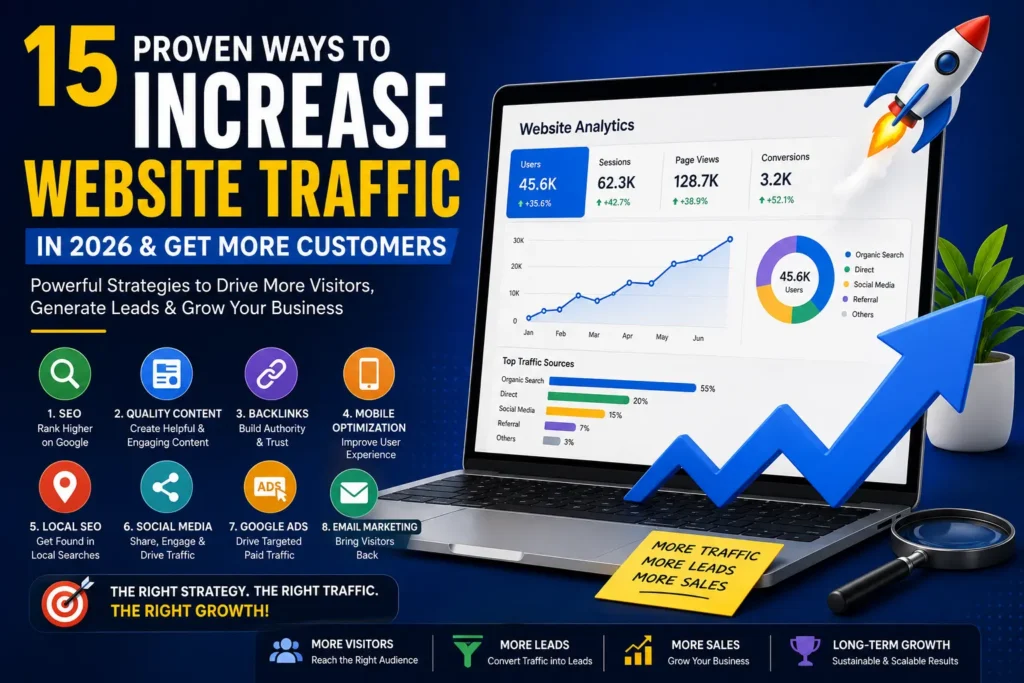
Getting visitors to your website is one of the biggest challenges businesses face online. You may have a professional website, excellent products, and valuable services, but if people cannot find your website, generating leads and sales becomes difficult.
The good news is that there are several proven ways to increase website traffic without relying on a single marketing channel.
From search engine optimization (SEO) and content marketing to Google Ads, social media, local SEO, and email marketing, businesses can combine multiple strategies to attract the right visitors and turn them into customers.
In this guide, you’ll discover 15 proven ways to increase website traffic in 2026, improve your online visibility, and create a sustainable source of leads and customers.
Why Website Traffic Matters for Business Growth.
Website traffic represents the number of people visiting your website. However, getting thousands of visitors isn’t necessarily enough.
The real objective is to attract relevant visitors who are interested in your products or services.
High-quality website traffic can help you:
- Generate more leads
- Increase sales
- Build brand awareness
- Improve search visibility
- Grow your customer base
- Establish industry authority
- Increase return on marketing investment
For example, 500 visitors searching specifically for your service can be more valuable than 10,000 visitors with no purchasing intent.
That’s why businesses should focus on targeted website traffic rather than traffic volume alone.
1. Optimize Your Website for SEO.
Search Engine Optimization remains one of the most effective ways to generate long-term organic website traffic.
SEO helps your website appear when potential customers search for relevant products, services, and information on Google.
Start by optimizing:
- Page titles
- Meta descriptions
- H1 and H2 headings
- Website content
- Internal links
- Images
- URLs
- Page speed
- Mobile experience
Focus on keywords that match your customers’ search intent instead of simply adding keywords everywhere.
2. Target Long-Tail Keywords.
Highly competitive keywords can be difficult to rank for, particularly for newer websites.
Long-tail keywords are more specific search phrases that often have stronger purchasing intent.
For example:
Broad keyword:
“Website design”
Long-tail keyword:
“Website design company for small businesses in Bangalore”
Long-tail keywords can help businesses attract highly relevant visitors while competing in more specific search results.
Create dedicated pages and helpful articles around these phrases.
3. Publish Helpful, In-Depth Content.
Content marketing is an excellent way to attract organic traffic.
Create content that answers questions your potential customers are already asking.
Examples include:
- How-to guides
- Tutorials
- Industry reports
- Comparisons
- Case studies
- Checklists
- FAQs
- Buying guides
Instead of publishing articles simply to target keywords, focus on solving genuine customer problems.
Helpful content can attract search traffic, earn backlinks, and encourage visitors to explore other pages on your website.
4. Build Topic Clusters.
Instead of publishing unrelated blog posts, organize your content around important topics.
For example, a digital marketing agency could create a main pillar page about SEO Services and supporting articles such as:
- How SEO Works
- Local SEO Strategies
- Technical SEO Guide
- SEO vs Google Ads
- How to Improve Google Rankings
- Common SEO Mistakes
Link these related articles together.
This creates a strong internal linking structure and helps search engines understand your website’s expertise.
5. Improve Your Website’s Technical SEO.
Technical problems can prevent search engines from properly crawling and understanding your website.
Check important areas such as:
- Mobile responsiveness
- Page loading speed
- HTTPS security
- XML sitemap
- Robots.txt
- Broken links
- Canonical URLs
- Indexability
- Structured data
- Core Web Vitals
A technically healthy website provides a stronger foundation for organic search growth.
6. Improve Your Google Business Profile.
If you operate a local business, Google Business Profile optimization can generate valuable website traffic and enquiries.
Keep your profile updated with:
- Accurate business information
- Correct category
- Website URL
- Phone number
- Business hours
- Photos
- Services
- Customer reviews
- Regular updates
Local search visibility can help potential customers discover your business and visit your website.
7. Use Google Ads for Immediate Traffic.
SEO is a long-term strategy, but businesses sometimes need traffic immediately.
Google Ads can place your business in front of people actively searching for your products or services.
For example, a website design company might target:
- Website design company
- Website development services
- WordPress website design
- Website designer near me
The key is to target high-intent keywords and send visitors to relevant landing pages.
Paid traffic can complement your long-term SEO strategy rather than replacing it.
8. Create Short-Form Video Content.
Video content can generate traffic from platforms such as YouTube, Instagram, and Facebook.
Create short videos around topics your audience cares about.
For example:
- SEO tips
- Website design mistakes
- Google Ads tips
- Marketing tutorials
- Industry trends
- Customer success stories
Include a relevant call-to-action that encourages viewers to visit your website for additional information.
9. Use Social Media to Distribute Content.
Publishing a blog post doesn’t guarantee that people will discover it.
Promote your content across relevant social media platforms.
You can share:
- Blog articles
- Infographics
- Videos
- Statistics
- Customer stories
- Educational posts
- Industry insights
Social media distribution can increase content exposure and introduce your website to new audiences.
10. Build High-Quality Backlinks.
Backlinks are links from other websites to your website.
Relevant, trustworthy backlinks can strengthen your website’s authority and help search engines understand that your content is valuable.
You can earn backlinks through:
- Original research
- Expert interviews
- Guest contributions
- Digital PR
- Industry resources
- Local business partnerships
- Valuable guides and tools
Focus on relevance and quality rather than trying to obtain hundreds of low-quality links.
11. Optimize Your Existing Content.
You don’t always need to publish new articles to increase traffic.
Look at your existing content and identify pages that already receive impressions but could perform better.
Improve them by:
- Updating outdated information
- Adding missing sections
- Improving headings
- Adding relevant keywords
- Strengthening internal links
- Improving readability
- Adding FAQs
- Updating statistics and examples
Refreshing existing content can be an efficient way to improve organic visibility.
12. Improve Your Internal Linking.
Internal links connect one page of your website to another.
For example, a blog about Google Ads could link to:
- Google Ads Management
- PPC Services
- Landing Page Design
- Lead Generation
- SEO Services
Internal linking helps visitors discover more content and makes it easier for search engines to crawl your website.
Use descriptive anchor text that clearly explains what the linked page is about.
13. Create Content Around Search Intent.
One of the biggest mistakes businesses make is creating content without understanding why people are searching.
Search intent generally falls into categories such as:
Informational Intent
The user wants to learn something.
Example:
“How does SEO work?”
Commercial Intent
The user is researching potential solutions.
Example:
“Best SEO services for small businesses”
Transactional Intent
The user is ready to take action.
Example:
“SEO company in Bangalore”
Create different types of content for each stage of the customer journey.
14. Use Email Marketing to Bring Visitors Back.
Website traffic doesn’t have to come entirely from new visitors.
Email marketing can bring existing audiences back to your website.
Send subscribers:
- New blog posts
- Special offers
- Industry insights
- Product updates
- Case studies
- Educational content
Building an email list gives your business a direct communication channel with potential and existing customers.
15. Measure Your Website Traffic and Conversions.
You cannot improve what you don’t measure.
Monitor important metrics such as:
- Organic traffic
- Direct traffic
- Referral traffic
- Search impressions
- Click-through rate
- Conversion rate
- Engagement
- Landing page performance
- Leads generated
- Cost per acquisition
Traffic is only one part of the equation.
The ultimate goal should be to turn relevant visitors into leads, customers, and revenue.
Website Traffic vs Quality Website Traffic.
More traffic isn’t always better.
Imagine two websites:
Website A: 20,000 visitors with a 0.5% conversion rate.
Website B: 5,000 visitors with a 5% conversion rate.
Website B may generate significantly more customers despite receiving fewer visitors.
This is why your marketing strategy should focus on qualified traffic.
Target people who:
- Need your product
- Need your service
- Are searching for solutions
- Match your target market
- Have purchasing intent
Common Website Traffic Mistakes to Avoid.
Avoid these common mistakes:
- Buying low-quality traffic
- Keyword stuffing
- Publishing thin content
- Ignoring technical SEO
- Targeting irrelevant keywords
- Creating content without search intent
- Ignoring mobile users
- Having slow-loading pages
- Not promoting your content
- Focusing only on traffic instead of conversions
Sustainable traffic growth comes from providing genuine value and creating a strong user experience.
How Long Does It Take to Increase Website Traffic?
The timeline depends on your website’s authority, competition, industry, content quality, and marketing strategy.
SEO generally takes longer to build than paid advertising, while Google Ads can generate traffic much faster.
A strong long-term approach is to combine:
SEO + Content Marketing + Local SEO + Google Ads + Social Media + Conversion Optimization
This creates multiple traffic sources instead of depending entirely on one channel.
Best Website Traffic Strategy for Small Businesses.
Small businesses don’t necessarily need to invest in every marketing channel simultaneously.
A practical strategy is:
Step 1: Fix Your Website
Make sure your website is fast, mobile-friendly, secure, and easy to navigate.
Step 2: Build SEO Foundations
Optimize your important service and location pages.
Step 3: Create Helpful Content
Publish articles answering customer questions.
Step 4: Build Local Visibility
Optimize your Google Business Profile and collect genuine reviews.
Step 5: Use Paid Advertising
Use Google Ads for high-intent keywords where immediate visibility matters.
Step 6: Track Results
Measure traffic, leads, conversions, and ROI.
Then invest more in the channels producing the best business results.
Final Thoughts.
Increasing website traffic in 2026 requires more than publishing a few blog posts or running advertisements. Successful businesses build a complete digital marketing strategy that combines SEO, helpful content, technical optimization, local search, paid advertising, social media, email marketing, and conversion optimization.
The most important principle is simple: don’t chase traffic—attract the right traffic.
When your website reaches people who genuinely need your products or services, traffic becomes much more valuable. With consistent optimization and a customer-focused strategy, your website can become a reliable source of leads, sales, and long-term business growth.
Frequently Asked Questions
How can I increase website traffic quickly?
Google Ads, social media promotion, email marketing, and content distribution can generate traffic relatively quickly. SEO is generally better suited for building sustainable organic traffic over time.
What is the best way to increase organic website traffic?
Focus on search intent, keyword research, high-quality content, technical SEO, internal linking, backlinks, and regularly updating existing content.
How can a small business get more website visitors?
Small businesses can combine Local SEO, Google Business Profile optimization, SEO content, social media, Google Ads, and referral marketing to attract relevant visitors.
Does blogging increase website traffic?
Yes. Consistently publishing useful content can create additional opportunities to rank for relevant search queries and attract potential customers.
Is paid traffic better than organic traffic?
Neither is universally better. Paid traffic can provide immediate visibility, while organic traffic can deliver sustainable results over time. Using both can create a balanced marketing strategy.
How do I turn website traffic into customers?
Optimize landing pages, use clear calls-to-action, build trust with reviews and testimonials, simplify contact forms, improve website speed, and create content that addresses customer needs.