
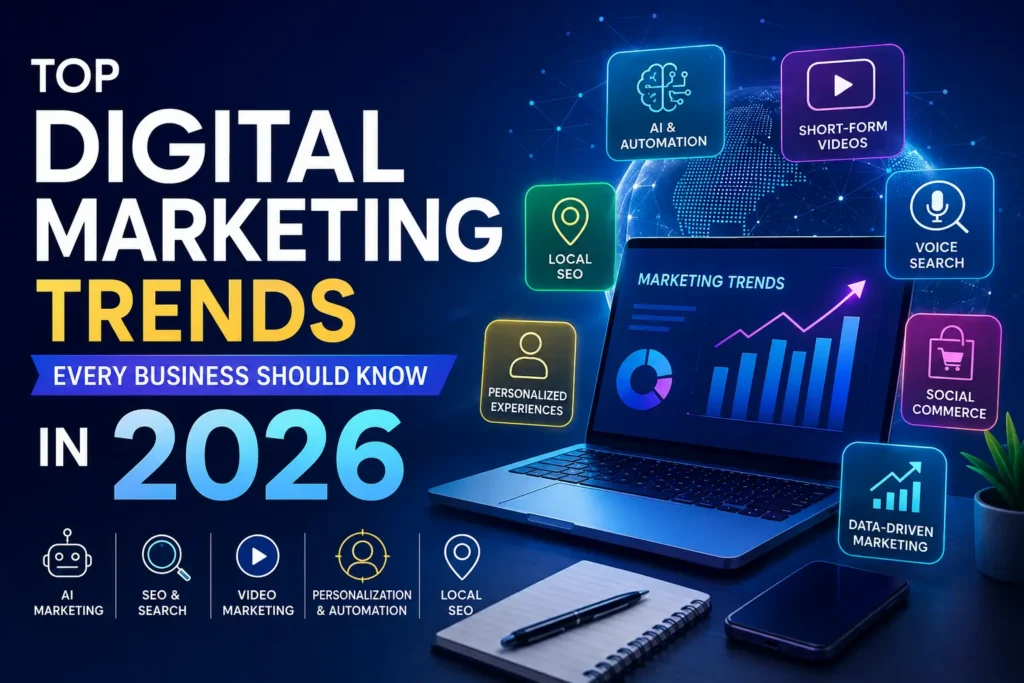
Digital marketing continues to evolve at an incredible pace. What worked a year ago may no longer deliver the same results today. As search engines become smarter, artificial intelligence transforms customer experiences, and consumer expectations rise, businesses must adapt quickly to stay ahead of the competition.
Whether you’re a startup, local business, eCommerce store, healthcare provider, real estate company, or enterprise, understanding the latest digital marketing trends is essential for attracting more customers, generating quality leads, and increasing revenue.
In this comprehensive guide, we’ll explore the top digital marketing trends every business should know in 2026 and explain how you can use them to build a stronger online presence.
Why Digital Marketing Matters More Than Ever.
Today’s customers research products online before making purchasing decisions. They compare brands, read reviews, watch videos, and expect personalized experiences across multiple platforms.
Businesses investing in digital marketing are seeing benefits such as:
- Increased website traffic
- Better brand awareness
- Higher-quality leads
- Improved customer engagement
- Greater return on investment (ROI)
- Stronger customer loyalty
Companies that fail to embrace modern marketing strategies risk falling behind competitors who leverage technology and data more effectively.
1. Artificial Intelligence Is Transforming Digital Marketing
Artificial Intelligence (AI) is no longer just a trend—it’s becoming the foundation of modern marketing.
AI helps businesses:
- Create content faster
- Improve customer support
- Analyze customer behavior
- Optimize advertising campaigns
- Generate marketing insights
- Personalize user experiences
AI-powered tools can recommend products, predict customer behavior, automate email campaigns, and optimize ad spending in real time.
However, successful businesses combine AI with human creativity. AI speeds up processes, while human expertise ensures content remains authentic, trustworthy, and emotionally engaging.
Related Keywords:
AI marketing, AI tools, AI content marketing, AI digital marketing strategy
2. Search Engine Optimization (SEO) Remains Essential
Despite the growth of social media and AI tools, SEO continues to deliver one of the highest returns on investment.
Google increasingly rewards websites that provide:
- Helpful content
- Fast loading speeds
- Mobile-friendly experiences
- Secure browsing (HTTPS)
- High-quality backlinks
- Clear website structure
Businesses should focus on creating content that answers real customer questions instead of simply targeting keywords.
Modern SEO Best Practices
- Publish in-depth content
- Optimize for search intent
- Use structured data
- Improve Core Web Vitals
- Build authority through quality backlinks
- Optimize images and videos
- Keep content updated regularly
SEO is a long-term investment that builds sustainable organic traffic without relying solely on paid advertising.
Related Keywords:
SEO services, Google ranking, local SEO, technical SEO, on-page SEO
3. AI Search and Conversational Search Are Changing SEO
Users increasingly search using conversational questions through AI-powered search experiences.
Instead of typing:
“SEO Bangalore”
People now ask:
“Which digital marketing agency offers affordable SEO services for small businesses in Bangalore?”
Businesses should create content that directly answers these natural-language questions.
Use:
- FAQ sections
- Conversational headings
- Long-tail keywords
- Detailed explanations
- Real-world examples
This approach improves visibility in both traditional search and AI-generated search results.
4. Short-Form Video Continues to Dominate.
Video remains one of the most effective ways to engage audiences.
Popular formats include:
- Instagram Reels
- YouTube Shorts
- LinkedIn videos
- Facebook Reels
- Product demonstrations
- Customer testimonials
- Behind-the-scenes content
Short videos capture attention quickly and often achieve higher engagement than static images.
Businesses should focus on educational, entertaining, and problem-solving content rather than purely promotional messages.
5. Personalization Creates Better Customer Experiences.
Customers expect brands to understand their preferences.
Personalization includes:
- Product recommendations
- Personalized email campaigns
- Location-based offers
- Dynamic website content
- Targeted advertising
- Customized landing pages
Businesses using customer data responsibly can improve conversion rates and customer satisfaction.
6. Local SEO Is More Important Than Ever.
For businesses serving specific cities or regions, local SEO is one of the most valuable marketing strategies.
Optimizing for local search helps customers find your business when searching for nearby services.
Important local SEO practices include:
- Optimizing your Google Business Profile
- Collecting customer reviews
- Using location-specific keywords
- Creating local landing pages
- Maintaining consistent business information across directories
For example:
- Digital Marketing Agency in Bangalore
- SEO Company in Bangalore
- Website Design Services in Bangalore
Local visibility often leads to higher-quality leads because users are actively looking for nearby businesses.
7. Voice Search Continues to Grow.
Voice assistants are changing how people search online.
Instead of typing short keywords, users ask complete questions.
Examples include:
- “Which is the best SEO agency near me?”
- “Who offers affordable website development?”
- “How much does Google Ads cost?”
Businesses should optimize content using conversational language and question-based headings to capture voice search traffic.
8. First-Party Data Is Becoming More Valuable.
As privacy regulations evolve and third-party cookies become less reliable, businesses need stronger first-party data strategies.
Examples include:
- Newsletter subscribers
- Customer accounts
- Loyalty programs
- CRM systems
- Website forms
Owning customer relationships helps businesses market more effectively while respecting user privacy.
9. Email Marketing Still Delivers Outstanding ROI.
Email marketing remains one of the highest-performing digital marketing channels.
Successful campaigns include:
- Educational newsletters
- Welcome sequences
- Product launches
- Promotional offers
- Customer follow-ups
- Abandoned cart reminders
Automation allows businesses to send relevant messages at the right time without manual effort.
10. Influencer Marketing Is Becoming More Authentic.
Consumers increasingly trust recommendations from creators who have engaged communities.
Micro-influencers often generate higher engagement because their audiences view them as more relatable.
Businesses should prioritize:
- Authentic partnerships
- Industry expertise
- Long-term collaborations
- Valuable content over promotional messaging
11. Interactive Content Improves Engagement.
Interactive experiences encourage users to spend more time on your website.
Examples include:
- Quizzes
- Calculators
- Assessments
- Polls
- Interactive infographics
- ROI calculators
Interactive tools also generate valuable first-party data while improving user engagement.
12. Marketing Automation Saves Time.
Automation improves efficiency across multiple marketing channels.
Businesses automate:
- Email campaigns
- Lead nurturing
- CRM workflows
- Customer support
- Social media scheduling
- Follow-up reminders
Automation allows teams to focus on strategy while repetitive tasks run automatically.
13. User Experience (UX) Influences Rankings.
Google increasingly rewards websites that provide excellent user experiences.
Key UX factors include:
- Fast loading speeds
- Mobile responsiveness
- Clear navigation
- Easy-to-read content
- Accessible design
- Secure browsing
A well-designed website not only ranks better but also converts more visitors into customers.
14. Social Commerce Continues to Expand.
Customers are increasingly purchasing directly through social media platforms.
Businesses should create:
- Shoppable posts
- Product videos
- Live demonstrations
- Customer testimonials
- Interactive stories
Reducing the number of steps between discovery and purchase increases conversions.
15. Building Trust Is the Biggest Competitive Advantage.
Consumers choose businesses they trust.
Trust is built through:
- Genuine customer reviews
- Transparent pricing
- Helpful educational content
- Industry expertise
- Case studies
- Testimonials
- Consistent branding
Google also favors trustworthy websites, making credibility essential for long-term SEO success.
How Businesses Can Prepare for the Future.
To stay competitive in 2026, businesses should:
- Invest in SEO and high-quality content.
- Use AI responsibly to improve efficiency.
- Prioritize user experience and website speed.
- Produce engaging short-form videos.
- Strengthen local SEO efforts.
- Build first-party customer relationships.
- Automate repetitive marketing tasks.
- Focus on trust, expertise, and customer satisfaction.
Digital marketing is no longer about using a single channel. The most successful businesses integrate SEO, paid advertising, social media, email marketing, content creation, and analytics into a cohesive strategy.
Final Thoughts.
Digital marketing in 2026 is driven by innovation, personalization, and trust. Businesses that embrace AI, create valuable content, optimize for search, invest in local SEO, and prioritize customer experience will be better positioned for sustainable growth.
Rather than chasing every new trend, focus on strategies that align with your business goals and deliver genuine value to your audience. By combining technology with human creativity, you can build stronger customer relationships, improve search visibility, and achieve long-term success in an increasingly competitive digital landscape.
Frequently Asked Questions (FAQs)
What is the biggest digital marketing trend in 2026?
Artificial Intelligence is transforming content creation, customer service, personalization, analytics, and campaign optimization, making it one of the most influential digital marketing trends.
Is SEO still worth investing in?
Yes. SEO remains one of the most cost-effective long-term strategies for increasing organic traffic, improving brand visibility, and generating qualified leads.
Why is local SEO important?
Local SEO helps businesses appear in location-based searches and Google Maps, making it easier for nearby customers to find and contact them.
How can small businesses benefit from digital marketing?
Digital marketing enables small businesses to reach targeted audiences, build brand awareness, generate leads, and compete with larger companies using measurable and cost-effective strategies.
Which marketing channel offers the highest ROI?
The answer depends on your goals, but SEO, email marketing, and targeted Google Ads campaigns consistently deliver strong returns when executed effectively.