
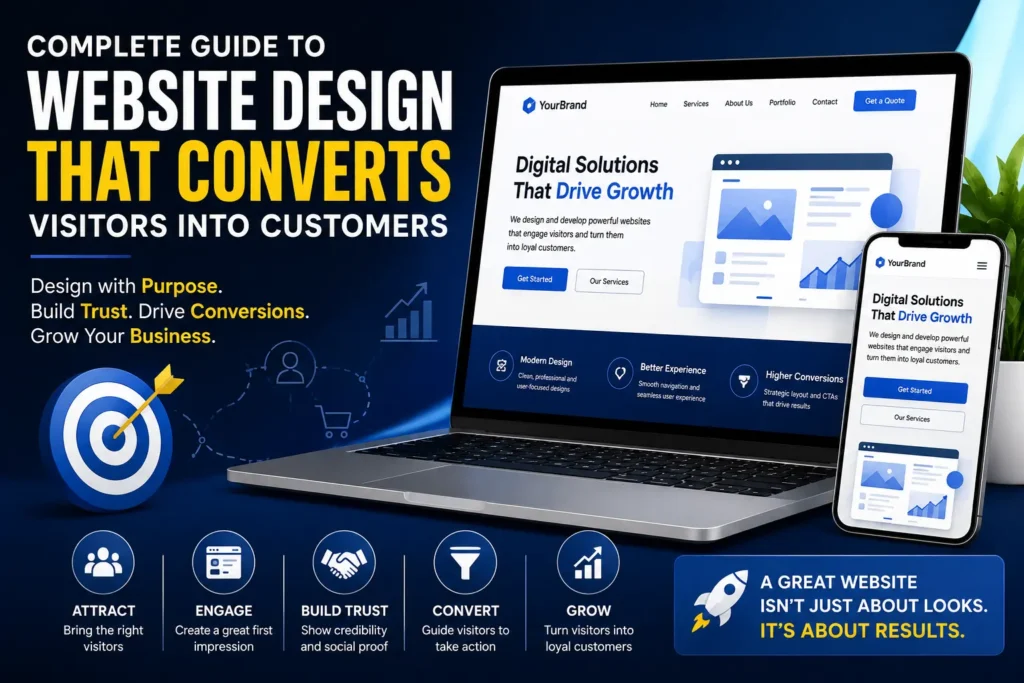
Your website is more than just an online presence it’s your 24/7 salesperson. A well-designed website doesn’t just look attractive; it builds trust, engages visitors, and encourages them to take action. Whether your goal is generating leads, increasing online sales, booking appointments, or growing brand awareness, your website plays a critical role in achieving business success.
In today’s competitive digital landscape, users decide within seconds whether to stay on your website or leave. Slow loading speeds, confusing navigation, poor mobile experiences, and weak calls-to-action can cost your business valuable customers.
This comprehensive guide explains how to create a website that not only attracts visitors but also converts them into loyal customers.
Why Website Design Matters.
Your website is often the first interaction potential customers have with your business. First impressions influence trust and purchasing decisions.
A professionally designed website helps you:
- Build credibility
- Improve user experience (UX)
- Increase search engine rankings
- Generate more qualified leads
- Improve conversion rates
- Strengthen brand identity
- Support long-term business growth
An effective website combines aesthetics with functionality, ensuring visitors can easily find information and complete desired actions.
What Is a High-Converting Website?
A high-converting website is designed to encourage visitors to perform specific actions, such as:
- Filling out a contact form
- Requesting a quote
- Booking a consultation
- Calling your business
- Making a purchase
- Subscribing to a newsletter
- Downloading a resource
Every page should guide visitors toward these conversion goals.
1. Understand Your Target Audience.
Successful website design begins with understanding your audience.
Consider:
- Who are your ideal customers?
- What problems are they trying to solve?
- What information do they need?
- Which devices do they use?
- What motivates them to take action?
Creating user-focused content and intuitive navigation significantly improves engagement and conversions.
2. Create a Clear Value Proposition.
Within seconds of landing on your website, visitors should understand:
- Who you are
- What you offer
- Why they should choose you
Your homepage should include:
- A compelling headline
- A concise supporting message
- Strong call-to-action buttons
- Professional imagery
- Trust-building elements
A clear value proposition reduces confusion and encourages users to explore further.
3. Prioritize User Experience (UX)
User experience directly affects bounce rates and conversions.
Best practices include:
- Simple navigation
- Logical page structure
- Easy-to-read typography
- Consistent branding
- Clear spacing
- Accessible design
- Minimal distractions
Visitors should never struggle to find important information.
4. Design for Mobile First.
Most users now browse websites on smartphones.
A mobile-friendly website should:
- Load quickly
- Use responsive layouts
- Have readable text
- Feature touch-friendly buttons
- Display forms correctly
- Avoid horizontal scrolling
Google also prioritizes mobile-friendly websites in search rankings.
5. Improve Website Speed.
Website speed has a major impact on user satisfaction and SEO.
Ways to improve speed:
- Compress images
- Use modern image formats
- Enable browser caching
- Minify CSS and JavaScript
- Use a Content Delivery Network (CDN)
- Choose reliable hosting
Faster websites keep users engaged and increase conversions.
6. Build Trust with Social Proof.
People trust businesses that others recommend.
Include:
- Customer testimonials
- Reviews
- Case studies
- Client logos
- Awards
- Certifications
- Success stories
Social proof reassures visitors and reduces hesitation.
7. Use Strong Calls-to-Action (CTAs)
Every important page should include clear calls-to-action.
Examples:
- Get a Free Quote
- Schedule a Consultation
- Contact Us Today
- Book a Demo
- Download the Guide
- Start Your Project
Use contrasting colors and action-oriented language to make CTAs stand out.
8. Optimize for SEO.
A beautiful website is ineffective if potential customers can’t find it.
SEO best practices include:
- Keyword research
- Optimized title tags
- Meta descriptions
- Header structure (H1–H3)
- Internal linking
- Image alt text
- Schema markup
- Fast page loading
- Mobile optimization
Creating helpful, original content improves visibility in search engines.
9. Create Engaging Content.
Content should educate, solve problems, and build trust.
Include:
- Service pages
- Blog articles
- FAQs
- Case studies
- Guides
- Videos
- Customer success stories
Quality content encourages longer visits and higher conversion rates.
10. Simplify Navigation.
Navigation should help users quickly find:
- Services
- About Us
- Portfolio
- Blog
- Contact Information
Avoid cluttered menus and keep navigation intuitive.
11. Use High-Quality Visuals.
Professional images, graphics, and videos improve credibility.
Best practices:
- Use authentic brand photography
- Optimize image sizes
- Maintain consistent branding
- Add descriptive alt text
- Avoid low-quality stock images where possible
Visuals should support your message—not distract from it.
12. Capture Leads Effectively.
Lead generation is a key goal for many business websites.
Include:
- Contact forms
- Live chat
- Click-to-call buttons
- Lead magnets
- Newsletter sign-ups
- Appointment booking
Keep forms short and easy to complete.
13. Add Trust Signals.
Visitors are more likely to convert when they trust your business.
Display:
- SSL certificate
- Privacy policy
- Secure payment badges
- Client reviews
- Industry certifications
- Years of experience
Trust signals reduce perceived risk.
14. Measure and Improve Performance.
Website optimization is an ongoing process.
Track metrics such as:
- Bounce rate
- Conversion rate
- Average session duration
- Page load speed
- Form submissions
- Click-through rates
Use analytics insights to identify opportunities for improvement.
Common Website Design Mistakes.
Avoid these mistakes:
- Slow loading pages
- Poor mobile responsiveness
- Confusing navigation
- Weak CTAs
- Too much text
- Broken links
- Outdated content
- Inconsistent branding
- Ignoring SEO
- No contact information
Fixing these issues can significantly improve user experience and conversions.
Website Design Trends in 2026.
Modern websites increasingly feature:
- AI-powered personalization
- Interactive content
- Minimalist layouts
- Dark mode options
- Micro-animations
- Voice search optimization
- Accessibility improvements
- Faster performance
- Advanced security features
Adopting relevant trends helps businesses remain competitive while enhancing the user experience.
Why Businesses Should Invest in Professional Website Design.
A professionally designed website helps you:
- Generate more leads
- Increase online sales
- Improve customer trust
- Strengthen brand identity
- Rank higher on Google
- Reduce bounce rates
- Improve conversion rates
- Support long-term business growth
Your website is one of the most valuable marketing assets your business owns.
Final Thoughts.
A successful website is not defined solely by its appearance—it is measured by its ability to convert visitors into customers. By focusing on user experience, mobile responsiveness, website speed, SEO, compelling content, strong calls-to-action, and trust-building elements, you can create a website that consistently delivers measurable business results.
Remember that website optimization is an ongoing process. Regular testing, performance monitoring, and continuous improvements will help your site stay competitive as user expectations and search engine algorithms evolve.
Investing in a high-quality website today can provide long-term benefits through increased traffic, stronger customer engagement, and higher conversion rates.
Frequently Asked Questions (FAQs)
Why is website design important for conversions?
A well-designed website improves user experience, builds trust, and makes it easier for visitors to complete actions such as contacting your business or making a purchase.
How can I make my website load faster?
Compress images, use reliable hosting, enable caching, minimize code, and optimize scripts to improve loading speed.
Does website design affect SEO?
Yes. Mobile responsiveness, page speed, user experience, navigation, and structured content all influence search engine rankings.
What makes a good call-to-action?
A good CTA is clear, action-oriented, visually prominent, and communicates the value users receive by clicking.
How often should a website be updated?
Review your website regularly and update content, design, security, and performance as your business evolves and industry trends change.